Can a PFP Be Considered Art?
Amid the rapid development of NFTs, digital collectibles, and blockchain culture, one debate continues to emerge around a seemingly simple question:
Can a PFP truly be considered art?
For some people, the answer is immediately no. A PFP is often perceived as nothing more than a digital profile picture: a character with different hairstyles, eyes, clothing, accessories, and backgrounds. Thousands of images are created from the same underlying visual structure and differentiated through various combinations of traits.
For those who define art through a narrow lens, this model can appear problematic.
“Isn’t it just the same image with different attributes?”
It is a valid question. But perhaps the more important question is this:
Since when have similarity, repetition, reproduction, or the function of an object determined whether something can be considered art?
If we take the history of art seriously, we quickly discover that art has never had a single permanent form. It has continuously evolved alongside technology, society, culture, and the ways human beings perceive reality.
Painting was once regarded as the highest form of artistic representation. Then photography emerged and transformed the way humans reproduced reality. This was followed by cinema, installation art, conceptual art, digital art, and eventually works created through code and blockchain technology.
Every time a new medium emerges, there is resistance.
Every generation has people who say:
“That is not art.”
Yet the history of art has repeatedly demonstrated that a medium alone does not determine the artistic value of a work.
The medium is merely the vehicle. Art is what a creator does with that vehicle.
From this perspective, PFPs are no exception.
A PFP can be art.
More than that, within the right context, PFPs may represent one of the most distinctive artistic forms of the internet and digital age.
Andy Warhol and When Repetition Becomes Art
To understand why PFPs can possess artistic legitimacy, we can look at one of the most important examples in the history of Pop Art.
In 1962, Andy Warhol created Marilyn Diptych.
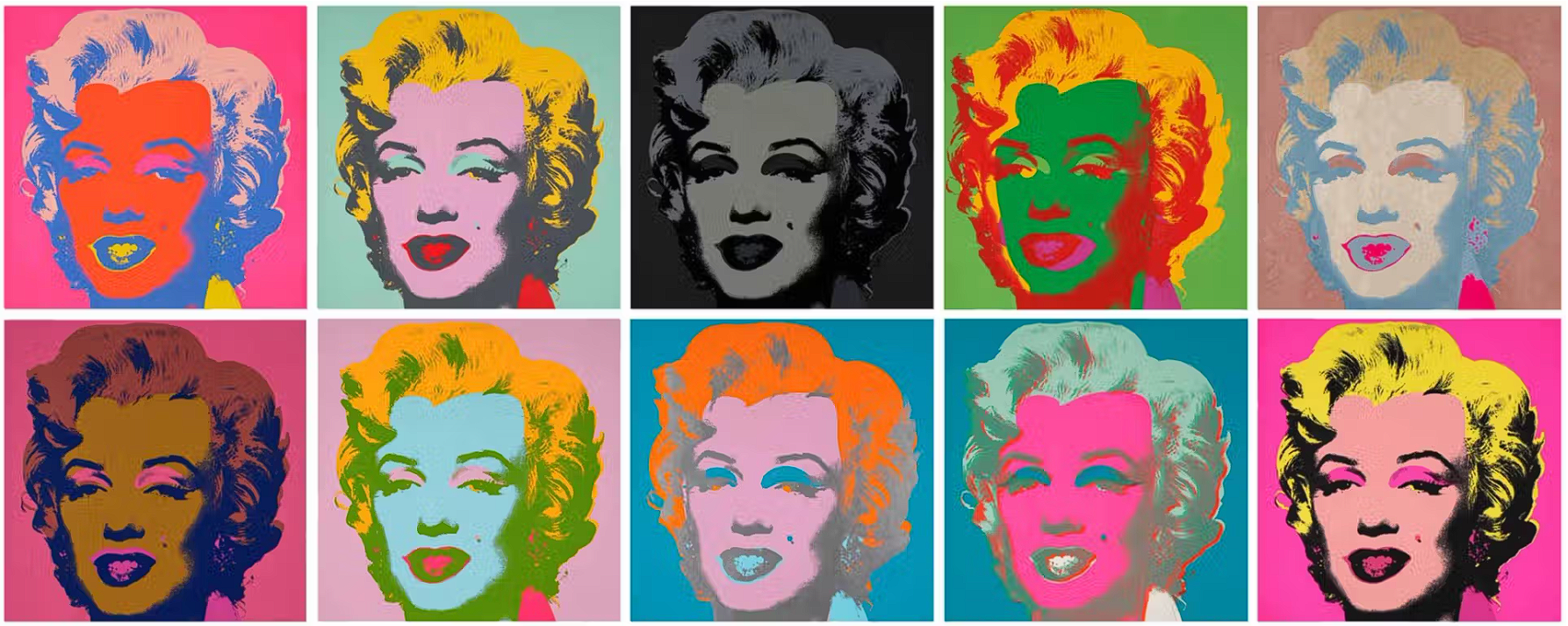
The work presents the face of Marilyn Monroe repeatedly. Dozens of representations of the same face are placed side by side within a single composition. One side is filled with bright and striking colors, while the other gradually fades into black and white.
At a superficial level, someone could look at the work and say:
“It is just one image of Marilyn Monroe printed over and over again.”
Technically, repetition is indeed one of the dominant elements of the work. But does repetition diminish its artistic value?
Quite the opposite. Repetition is a fundamental part of the work’s visual language.
Andy Warhol lived during the expansion of American mass culture. The world was becoming increasingly saturated with advertising, television, celebrities, consumer products, and endlessly reproduced images.
The face of a celebrity was no longer simply the face of a human being. It became a symbol. It was reproduced. Printed. Sold. Seen repeatedly. Consumed by the public.
Within this context, Warhol was not simply depicting Marilyn Monroe. He was using repetition as a concept.
The repetition in Marilyn Diptych speaks to popular culture, mass reproduction, celebrity, visual consumption, and, to a certain extent, mortality and the gradual loss of individual identity behind a cultural icon.
Marilyn Monroe’s face appears repeatedly. Yet the more often we see it, the less personal it begins to feel. Marilyn transforms from a human being into an image. An icon. A cultural product. And this is where we find an important lesson for understanding PFPs.
Repetition does not automatically eliminate artistic value.
Within the right context, repetition itself can become an artistic language.
From Repetition to Variation
If Andy Warhol used repetition as part of his visual language, PFPs bring a similar principle into the digital environment.
However, PFPs are not solely about repetition. PFPs are about repetition and variation.
A typical PFP collection begins with a shared base character. That character is then transformed through numerous variations. Different hair. Different eyes. Different expressions. Different clothing. Different accessories. Different backgrounds.
In some collections, every combination also possesses its own rarity and distinct identity.
A common criticism is:
“All of those characters look the same.”
But the question we should ask is:
Does a shared visual structure eliminate the artistic value of the variations created within it?
Not necessarily.
Throughout the history of art, variations of a shared form have been explored for centuries.
A painter may depict the same subject under different lighting conditions. A photographer may capture the same subject from different perspectives. An artist may repeatedly explore a particular form throughout an entire career.
A musician may work within the same musical structure while creating entirely different compositions.
Similarity is not the opposite of creativity.
In fact, a system or limitation can often create new possibilities for artistic exploration.
Within the context of PFPs, the base character can be understood as visual DNA.
Each trait then becomes a form of mutation. Every combination produces a new identity.
A character may share the same facial structure as another, yet through different combinations of visual elements, it can develop a dramatically different personality.
This is where PFPs introduce an element that is particularly significant.
PFPs create individuality through a system.
A PFP Is More Than Just an Image
One of the biggest mistakes people make when evaluating PFPs is judging the entire phenomenon through a single individual image.
A PFP can certainly stand alone as a visual work.
However, in many cases, the actual artwork is the entire system behind the collection.
Imagine a collection consisting of 10,000 characters. Each possesses a different combination of traits. Each character occupies a position within a larger visual system. No individual character can be completely separated from the collection to which it belongs.
They are individuals. But they are also part of a larger whole.
Within this context, a PFP collection can be understood as a form of generative art or even system-based art.
The artist is not simply creating a single image. The artist is creating:
- A visual language;
- A character structure;
- Rules of combination;
- A hierarchy of traits;
- Aesthetic limitations;
- Possibilities for variation;
- and a universe capable of expanding over time.
The final result is not merely an image. The final result is an entire visual ecosystem.
This is where we need to distinguish between a PFP as an individual image and a PFP collection as an artistic system.
Someone may look at a single character and find nothing extraordinary. But when thousands of those characters are placed together, a larger pattern begins to emerge.
Diversity. Repetition. Rarity. Identity. Community. Narrative. Culture.
A single character becomes part of a visual network far larger than itself.
In other words:
Sometimes the artwork is not just the individual piece. Sometimes the artwork is the entire system that allows thousands of individual pieces to exist.
“But PFPs Were Made to Be Profile Pictures”
Another argument frequently used to dismiss PFPs concerns their function.
PFPs, or Profile Pictures, are indeed designed to serve as visual identities on the internet. But since when has the function of an object eliminated its artistic value?
A poster has a function. Clothing has a function. A building has a function. A chair has a function. An album has a function as a medium for storing music. Yet function does not automatically eliminate aesthetic or artistic value.
A work can possess a function while simultaneously possessing artistic value.
In fact, the relationship between function and aesthetics has long been one of the most important areas of exploration in art and design.
A PFP can function as an avatar. But when someone chooses and uses a particular PFP, something deeper may also be taking place. They are constructing a digital identity. On the internet, our physical faces are not always present.
Avatars take on that role.
The character a person chooses becomes a visual representation of their identity within a digital environment. That choice can be personal.
Aesthetic. Cultural. Even ideological.
A person is not merely saying:
“This is my profile picture.”
They may also be saying:
“This is the visual identity I choose to represent myself.”
Within this context, PFPs have an interesting relationship with the history of portraiture.
For centuries, human beings have used portraits to represent identity. Kings and aristocrats commissioned paintings of themselves. Photography later assumed a similar role.
Today, in the digital era, people increasingly use avatars and characters to represent themselves.
Are all such representations automatically art?
No.
But does the fact that a digital image serves as an identity mean that it cannot be art?
Also no.
Function does not erase artistic value.
Art Has Never Stood Still
One of the fundamental problems in the debate surrounding PFPs is the tendency to use the standards of the past to judge the mediums of the future.
People are accustomed to seeing paintings displayed in museums.
Then they ask:
“Does a PFP look like a painting?”
Of course not.
But a PFP does not need to be a painting. Photography does not need to be painting. Film does not need to be theatre. Digital art does not need to be sculpture.
Blockchain art does not need to follow the traditional distribution systems of conventional galleries.
Every medium possesses its own characteristics.
PFPs were born from the internet. They evolved through social media. They live within digital communities. They can be collected on-chain. They can be used as identities. They can evolve into brands. They can build mythologies. They can create entire subcultures.
Therefore, evaluating PFPs as nothing more than static images means ignoring the context from which they emerged.
Every work of art has a relationship with its era. Cave paintings represented prehistoric humanity. Religious paintings reflected societies centered around spirituality and faith. Pop Art reflected consumer culture and mass media.
It is therefore entirely logical that art in the internet age would produce new forms connected to:
- Digital identity;
- Online communities;
- Avatars;
- Algorithms;
- Generative systems;
- Ownership;
- Blockchain;
- and meme culture.
PFPs are products of their time. And like every new artistic form before them, they may not be immediately accepted by everyone.
However, one important distinction must be made honestly.
Saying that PFPs can be art is not the same as saying that every PFP is automatically great art.
These are two entirely different statements.
Not every painting is a masterpiece. Not every photograph possesses significant artistic value. Not every film is a cinematic achievement. Not every sculpture has cultural significance.
The same applies to PFPs.
Some PFPs are created without a strong artistic vision. Some merely follow trends. Some are created purely for speculation. Some lack visual originality.
And criticism of those works is entirely valid.
However, the weaknesses of certain works within a medium cannot be used to reject the entire medium itself.
We cannot say that photography is not art simply because millions of bad photographs exist. We cannot say that music is not art simply because some songs lack depth.
Likewise, we cannot say:
“PFPs are not art because many PFPs were created to make money.”
Commercial motivation is nothing new in the history of art.
Artists have received patronage, sold works, accepted commissions, and created for the market for centuries. The commercial and the artistic have never necessarily existed in opposition to one another.
A work can possess economic value. A work can become a collectible. A work can be traded. And it can still be art.
The more relevant questions are:
Is there artistic intention behind it?
Does it possess a visual language?
Is there a concept behind the work?
Does it have cultural context?
Does it offer a particular perspective or experience?
If the answer is yes, then rejecting a work simply because it exists in the PFP format is an excessively narrow way of evaluating art.
PFPs as the Visual Language of the Digital Age
Ultimately, PFPs may not need permission from the traditional art world to become art. History will always conduct its own process of selection.
Some collections will be forgotten. Some will survive. Some may become nothing more than artifacts of a passing trend. Others may eventually become important representations of the digital culture of their generation.
The same has happened with nearly every artistic movement throughout history.
Not every work survives. But the fact that some works disappear does not mean that the movement itself never possessed value.
Today, we live in a world where identity is increasingly constructed through screens. We work through screens. We communicate through screens. We build communities through screens. We even introduce ourselves through screens.
It is therefore entirely natural that digital visual identity has become an important part of human expression.
PFPs are one manifestation of that reality. A small character can become an identity. An identity can become a symbol. A symbol can bring people together into a community. A community can create culture. And culture is one of the places where art lives.
Andy Warhol showed us that a face reproduced repeatedly could become a work of art capable of representing its era.
PFPs are doing something different today, but there is an interesting conceptual relationship. A character is reproduced through a system. It then undergoes thousands of variations. Each variation can be owned, used, displayed, and given meaning by a different individual.
Repetition becomes identity.
Variation becomes individuality.
Collection becomes culture.
And when a visual system transcends its technical function to create identity, narrative, expression, and culture, we are no longer simply looking at a profile picture.
We are looking at a new form of visual language.
PFP IS ART
So, is a PFP art?
The answer should not depend on whether the work was created with oil paint, a camera, a digital tablet, pixels, or an algorithm.
Art has never been defined solely by its medium.
A repeatedly reproduced face can become a masterpiece. An everyday object can become art when placed within a new context.
A digital image can become a cultural symbol. And a pixelated character can possess artistic value that extends far beyond the dimensions of its canvas.
PFP is a format.
Just as a canvas is a format. Just as film is a format. Just as photography is a format.
What matters is what a creator does within that format.
Are they simply creating an image?
Or are they building a visual language?
Are they simply creating characters?
Or are they constructing identities and mythologies?
Are they simply producing thousands of variations?
Or are they creating an artistic system capable of representing its era?
Those are the questions we should be asking.
Not:
“Is it just a PFP?”
But:
“What does this PFP represent?”
“What does it communicate?”
“What culture does it create?”
“And what will remain after the hype is gone?”
Because ultimately, art has never stopped evolving.
And perhaps one of the greatest mistakes we can make is rejecting a new artistic form simply because we are still using old definitions to understand it.
A PFP is not less artistic simply because it can be used as a profile picture.
Its function does not erase its artistic potential. Its repetition does not eliminate its originality. And its digital nature does not make it less legitimate than any other artistic medium.
PFP is a format. Art is what you do with it.
– NOXtoshi // SKHELL Culture Media
- All Posts
- Digital Collectibles
- Painting
- Post
- Back
- PunkFellas
- Marilyn On Chain
- BitMonkees
- SKHELL