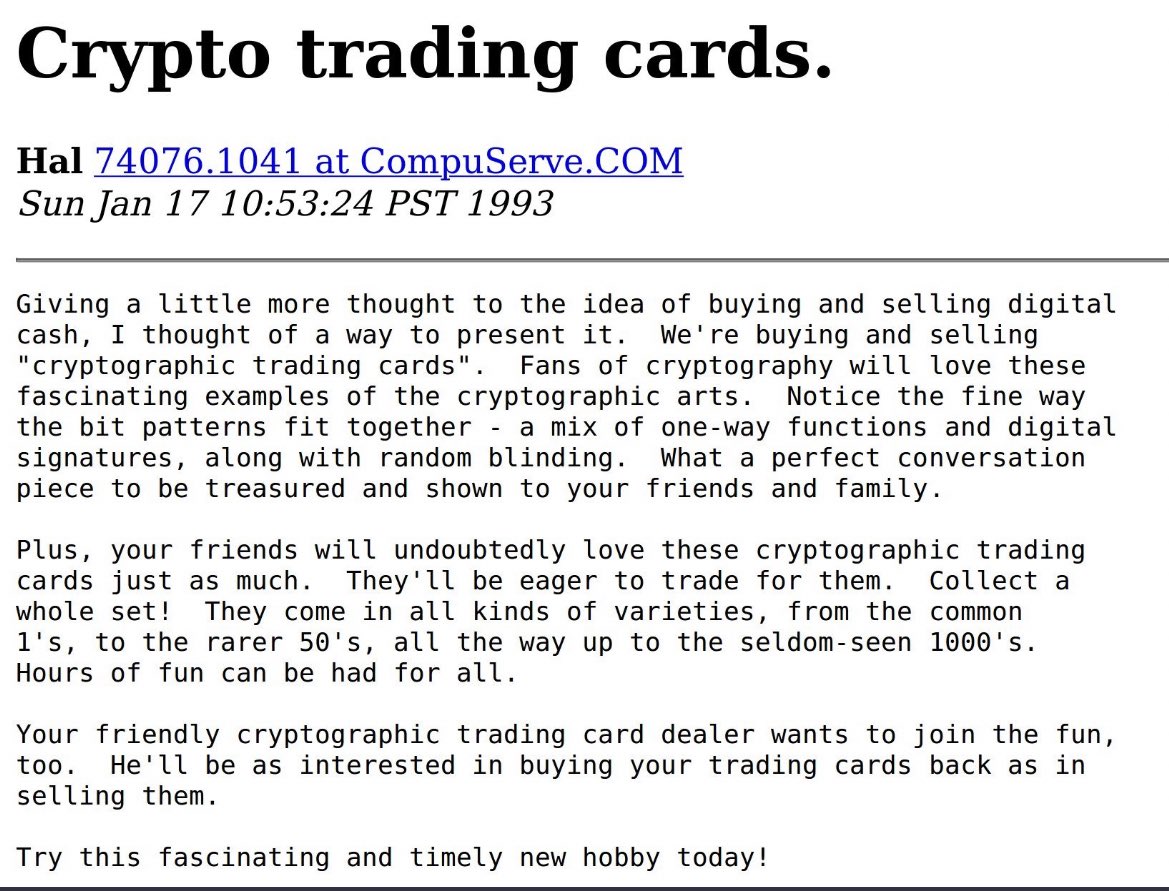
“Giving a little more thought to the idea of buying and selling digital cash, I thought of a way to present it. We’re buying and selling “cryptographic trading cards”. Fans of cryptography will love these fascinating examples of the cryptographic arts. Notice the fine way the bit patterns fit together – a mix of one-way functions and digital signatures, along with random blinding. What a perfect conversation piece to be treasured and shown to your friends and family.
Plus, your friends will undoubtedly love these cryptographic trading cards just as much. They’ll be eager to trade for them. Collect a whole set! They come in all kinds of varieties, from the common 1’s, to the rarer 50’s, all the way up to the seldom-seen 1000’s. Hours of fun can be had for all.
Your friendly cryptographic trading card dealer wants to join the fun, too. He’ll be as interested in buying your trading cards back as in selling them.
Try this fascinating and timely new hobby today!!”
From Cryptographic Trading Cards To Ordinals
I’m writing my own perspective on Hal Finney’s 1993 message to the Cypherpunks about Cryptographic Trading Cards — re-examining it through my own lens and understanding.
A Straight Line That Was Never Broken
On January 17, 1993, Hal Finney sent a modest email to the Cypherpunks mailing list. It wasn’t dramatic. It wasn’t presented as a manifesto. It wasn’t framed as a revolution. It was an idea.
He called it: cryptographic trading cards.
At the time, many may have read it as a playful analogy for digital cash. A conceptual exercise. A way to explain blind signatures and cryptographic scarcity using something culturally familiar. But three decades later, from my perspective, living in the era of Bitcoin and Ordinals, it is clear: It wasn’t a metaphor. It was a vision.
What Hal Finney Actually Saw
Finney was not talking about JPEGs. He was not talking about speculation. He was not talking about hype cycles. He was talking about structure. He saw how:
- One-way functions
- Digital signatures
- Random blinding
could create digital objects that were:
- Unique
- Verifiable
- Unforgeable
- Transferable
- Collectible
This is crucial.
He didn’t begin with art. He didn’t begin with markets. He began with mathematics. Yet he chose the term “trading cards.” Why?
Because he understood human psychology. Humans collect. We collect baseball cards. We collect stamps. We collect rare coins. We collect figurines. The value of those objects is rarely in their physical material. It is not the cardboard, not the ink, not the plastic.
Their value emerges from:
- Scarcity
- Authenticity
- Narrative
- Culture
Finney understood something profound: Cryptography could manufacture digital scarcity. And once scarcity becomes verifiable without central authority, it becomes property.
1993: The Missing Piece
In 1993, one fundamental problem remained unresolved: double-spending. Digital objects could be copied infinitely. Scarcity was theoretical, not final.
The system Finney imagined still implicitly relied on some issuing structure, some trusted process to maintain uniqueness. The direction was correct. But the infrastructure did not yet exist. That infrastructure arrived in 2009 with the release of Bitcoin by Satoshi Nakamoto. Bitcoin solved double-spending through:
- Proof-of-Work
- A distributed ledger
- Permissionless global consensus
For the first time in history, digital scarcity became objective. Not promised. Not simulated. But enforced by energy and mathematics. Finney imagined the cards. Satoshi built the ground they could stand on.
Ordinals: When the Idea Became Literal
Three decades after that email, the Ordinals protocol emerged. For the first time in Bitcoin’s history:
- Individual satoshis could be identified
- Ordered
- And permanently inscribed with data
NOT TOKENS ON A SEPARATE LAYER. NOT REFERENCES TO EXTERNAL SERVERS. NOT METADATA DEPENDENT ON IPFS.
The data lives inside Bitcoin itself. Immutable. Secured by proof-of-work. Embedded in the most resilient ledger ever created. And suddenly, we are back in 1993: Cryptographic trading cards.
Except now, they are no longer conceptual. They are literal.
Hierarchies of Scarcity: The Collector’s Mind
In his email, Finney described variations:
- Common 1s
- Rarer 50s
- Seldom-seen 1000s
He understood that collections require hierarchy. Scarcity must be structured.
Ordinals replicate this psychological framework:
- Rare sats
- Uncommon sats
- Early block inscriptions
- First 10k inscriptions
- 1/1 pieces
- Trait rarity systems
Collectors are not merely buying images. They are buying:
- Historical position
- Context
- Narrative
- Cultural alignment
Collection is not transactional. It is psychological and civilizational.
The Fundamental Difference: Permanence Without Issuer
There is one critical distinction between 1993 and today. In 1993, systems still required implicit issuers.
With Bitcoin-based inscriptions: The issuer can disappear. The marketplace can shut down. The creator can vanish. But the inscription remains. The network continues. No central server. No private database. No kill switch.
This is what makes Ordinals the purest realization of cryptographic trading cards ever conceived. Not as a controlled experiment. But as sovereign digital property.
Culture Is Utility
A common question arises: “What is the utility?”
This question reflects a strictly utilitarian worldview, one that demands practical function to justify value. But Finney was not describing functional tools. He described fascination. Conversation pieces. Tradable artifacts. Collectible units. He understood that value can emerge from culture.
When people collect Ordinals, they are not merely participating in a marketplace. They are constructing:
- Identity
- Community
- Aesthetic language
- Shared narrative
And when culture forms, utility emerges organically:
- Brands form
- Collaborations arise
- Micro-economies develop
- Historical value compounds
Culture is not a byproduct. Culture is the engine of value.
Bitcoin as the Mother Chain
If cryptographic trading cards were born from cypherpunk DNA, then their most logical evolutionary home is Bitcoin. Bitcoin is not merely the first blockchain. It is the most battle-tested. The most decentralized. The most censorship-resistant. The most durable.
If we are speaking about generational collectibles, permanence matters more than speed. Other chains may be faster. Cheaper. More flexible. But permanence commands a premium.
True collectors understand that.
An Ideological Continuum
There is a clear ideological line:
From Cypherpunks, to Satoshi Nakamoto, to Bitcoin, to Hal Finney, to Casey Rodadmor, to Ordinals, to Digital Collectibles, to Digital Collectors.
The cypherpunks fought for privacy and sovereignty. Bitcoin materialized those principles into money. Ordinals extended them into digital artifacts. Today’s collectors, those who understand this lineage, are not merely traders. They are participants in the evolution of digital property rights.
This Is Not Hype. It Is Human Pattern
Hype cycles rise and collapse. But:
- Physical trading cards have survived for decades.
- Rare coins have been collected for centuries.
- Stamps still hold value long after letter-writing declined.
Collecting is an ancient human instinct. Ordinals are not a passing trend. They are a new form of an old behavior. Hal Finney saw that instinct long before the world was ready.
A Vision That Never Died
When Hal Finney wrote about cryptographic trading cards in 1993, he was not joking.
He was imagining a world in which cryptography could create collectible digital objects that were:
- Unique
- Verifiable
- Unforgeable
- Transferable
- Culture-forming
Today, Ordinals on Bitcoin represent the closest realization of that vision. Not as metaphor. But as mathematical reality. Every time someone inscribes a satoshi, they are participating in a concept imagined more than three decades ago.
A straight line that was never broken. From a quiet mailing list email to permanent artifacts embedded in the most resilient ledger humanity has ever created.
Cryptographic trading cards. Now living inside Bitcoin blocks. And history, once imagined, has been inscribed.
-NOXtoshi-